FILTER INFUSER water bottle
The KLEAN Cup represents an evolution in portable water filtration, combining advanced purification with an enhanced drinking experience. Utilizing hollow fiber membrane technology capable of filtering contaminants down to 0.01 microns,
the system delivers clean, safe drinking water using filtration technology commonly found in medical and
biotechnology applications.
The client’s vision extended beyond filtration by integrating a removable infuser, allowing users to add fruit, tea, or other natural flavors. Through research and prototyping, we identified a key challenge with hollow fiber filtration: the high suction force required by traditional filter bottles and straws, resulting in a poor user experience.
Our solution replaced continuous suction with a simple one-time plunger mechanism that rapidly forces water through the filter, instantly purifying an entire bottle for effortless drinking. By rethinking the interaction rather than the filter itself, we created a more intuitive, comfortable, and enjoyable hydration experience.
BACKGROUND
Our engagement began with a design brief to develop a high-capacity water bottle for outdoor enthusiasts and individuals living in regions with limited access to clean drinking water. Through product and technology research, we identified hollow fiber membrane filtration as the optimal solution while uncovering key user pain points, including high suction force and poor-tasting filtered water.
Using these insights, we conducted structured ideation to develop a solution that addressed both functional challenges and user experience. The result was a differentiated product concept that combined effortless filtration with an integrated infuser, creating a portable hydration system designed to appeal to both adventure and everyday markets.


Visualization
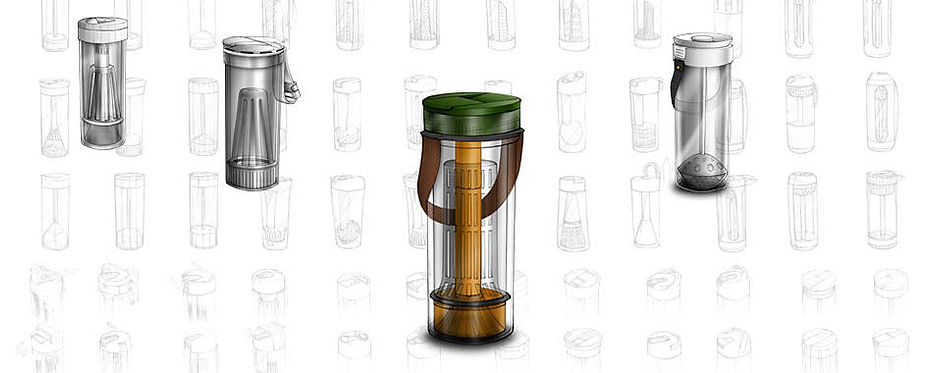
Throughout our industrial design, engineering, and branding process, we create high-quality visualizations that communicate product concepts to clients, investors, and future customers. These visuals help evaluate form, architecture, functionality, ergonomics, and user interactions while guiding decisions around colors, materials, and finishes aligned with market trends and target users.
Beyond product development, these renderings become valuable marketing assets for presentations, crowdfunding, websites, and promotional campaigns. By creating production-quality visuals early, we accelerate decision-making, reduce development costs, and improve speed to market.

design for manufacturing (dfm)
From the outset of the project, scalability was a core design objective. KLEAN was no exception. Our strategy focused on quickly understanding the cost implications of a sophisticated product while validating its technical and commercial feasibility. A key component of this process was identifying cost-effective filter technologies, including the evaluation and integration of existing components where appropriate.
The custom bottle was designed using post-consumer HDPE that is free of BPA, phthalates, heavy metals, and common allergens. This material provided a safe, durable, and sustainable solution that could be manufactured efficiently through injection molding while improving recyclability and reducing environmental impact.
Design for Manufacturing (DFM) principles were incorporated throughout the product architecture, with particular emphasis on simplifying assembly and disassembly to support circular design methodologies, facilitate end-of-life recycling, and improve long-term manufacturability.


prototyping
From the first proof-of-concept prototype, we validated the core design, demonstrating both the feasibility of the concept and significant improvements in usability. Subsequent Engineering Validation Testing (EVT) and Design Validation Testing (DVT) further refined the product, confirming that the KLEAN cup met its performance objectives and delivered the premium user experience envisioned from the outset.
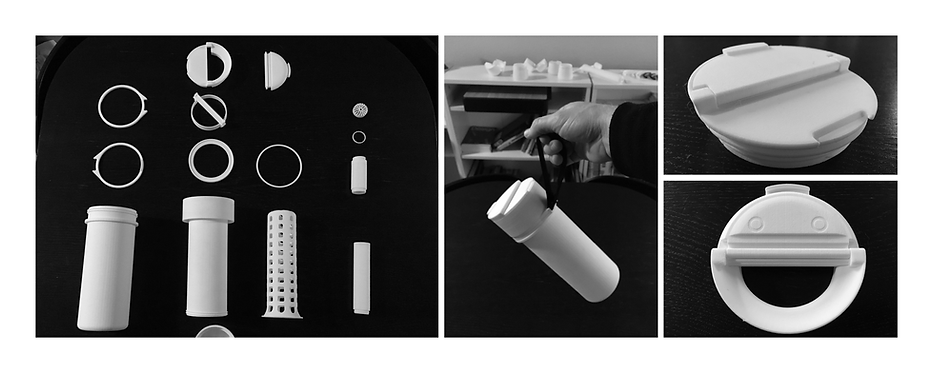
As development progressed, prototypes evolved from low-fidelity SLS 3D-printed parts to high-fidelity CNC-machined components with production-quality finishes. With each iteration, manufacturing precision, tolerances, and overall product quality improved.
Throughout the prototyping process, each iteration was used to evaluate and enhance the user experience, ensuring the final design met the highest standards for usability, functionality, consumer appeal, and manufacturability.
engineering
Engineering the KLEAN cup required a design-led approach that balanced user experience, manufacturability, and technical performance. Product engineering focused on developing a robust multi-part construction, optimizing mechanical features such as screw-thread interfaces, and standardizing components to simplify manufacturing while maintaining a premium appearance. Existing filtration components were evaluated and integrated, reducing development risk and improving scalability.
Throughout development, extensive CAD modeling, simulations, and engineering evaluations were used to refine product performance, ergonomics, and assembly. Key design considerations included maximizing internal capacity while maintaining a footprint compatible with standard vehicle cup holders, optimizing filtration performance and cartridge longevity, and incorporating a fruit infusion function without compromising functionality. The resulting design delivered a versatile, manufacturable product that successfully balanced performance and user experience.

concept development
The KLEAN cup was developed through a research-led industrial design process that combined user insights, market analysis, and technical feasibility to establish a strong product foundation. Early development included identifying the primary customer, evaluating emerging hydration and filtration technologies, conducting intellectual property research, and benchmarking competing products to uncover opportunities for innovation and differentiation. Market trends and consumer behavior further informed the product strategy, ensuring the solution aligned with both outdoor enthusiasts and daily users, meeting current demands and future market potential.
Structured brainstorming and iterative ideation sessions explored a broad range of concepts before converging on a distinctive design direction. Throughout concept development, color, material, and finish (CMF) studies were used to reinforce the desired product positioning and create a cohesive brand experience. By integrating industrial design, engineering, and brand strategy from the outset, the final concept achieved a unique visual identity that communicates precision, transparency, and trust while balancing long-term commercial viability.